

You usually do not hear the term lateral drain until there is a problem. Perhaps a CCTV survey has found a blockage, a drainage search has flagged a pipe, or planned building work has raised an awkward question: who actually owns it?
The term has a specific legal meaning under the Water Industry Act 1991, but responsibility can still depend on how the drainage system is arranged and where the pipe connects.
Ownership is not always obvious from where the pipe sits. A drain beneath a garden can fall under a sewerage company's responsibility, while a pipe beyond a boundary is not automatically public.
This guide explains how to tell the difference, who normally deals with repairs, and what to check when a lateral drain becomes blocked or damaged.
What Is a Lateral Drain?
A lateral drain is the section of a property’s drainage that runs from the curtilage of a building to the sewer it connects with. In everyday terms, it is usually the length of pipe that continues after the private drainage serving your home leaves the area associated with the property.
Its job is to carry wastewater or surface water onward towards the sewer network. The route is not limited to a road or pavement. Depending on the layout, the pipe may pass beneath a driveway, verge, shared access or neighbouring land before reaching the sewer.
The legal definition uses curtilage, which broadly refers to the land closely associated with a building. Homeowners often use property boundary as a simpler reference point, but the two terms are not always identical.
A lateral drain also should not be confused with a shared drain. A drain normally serves one building or buildings within the same curtilage. Once flows from separate properties combine, the downstream pipe will generally meet the definition of a sewer.
Typical layout: House → private drain → curtilage → lateral drain → sewer
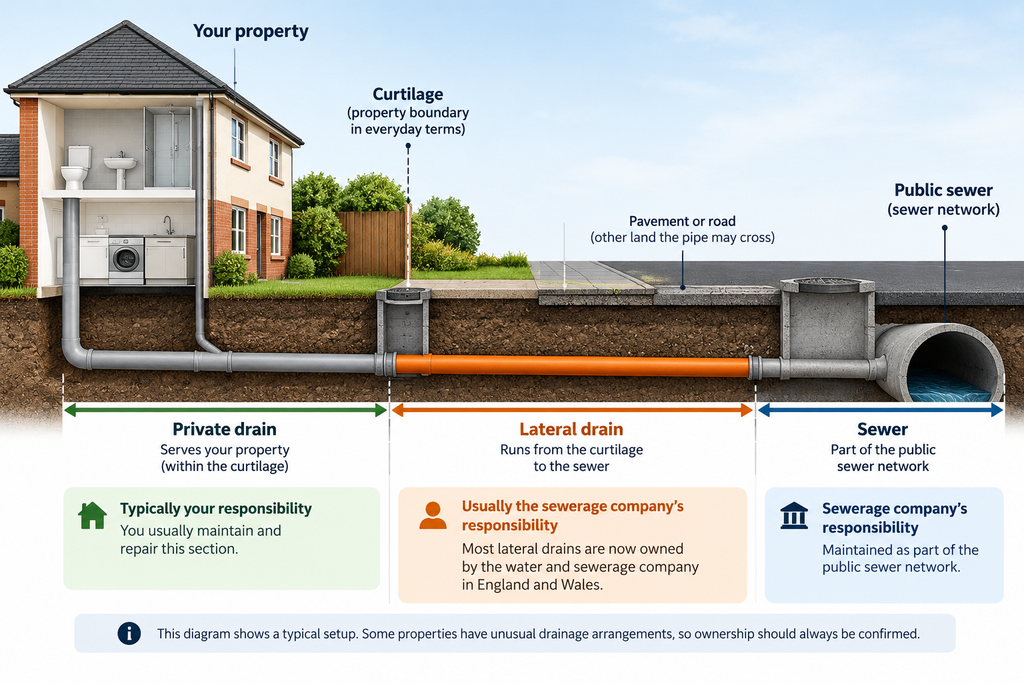
Responsibility commonly changes along that route, so unusual drainage arrangements should always be confirmed rather than assumed.
What Is the Difference Between a Private Drain, Lateral Drain and Sewer?
These terms describe different sections of the pipework carrying water away from a property. They matter because responsibility for a blockage or repair may change as the pipe travels away from the house.
| Drainage type | What it does | Typical location | Typical responsibility in England and Wales |
| Private drain | Carries drainage from one property | Usually within the property's curtilage | Property owner |
| Lateral drain | Continues that drainage towards the sewer | Usually beyond the originating property's curtilage | Sewerage company where the pipe is public or adopted |
| Sewer | Carries drainage from more than one property | May run through public or private land | Sewerage company where it forms part of the public network |
From the house, wastewater may first enter a drain serving only that property. If the same pipe continues beyond the curtilage before reaching the sewer, that section may be classed as a lateral drain. Farther along, once drainage from another property joins the run, it will generally fall within the definition of a sewer.
The pipe's position on the ground can be misleading. A run beneath a garden may form part of the public network, while another outside the apparent property boundary may not. If responsibility is unclear, the drainage layout and adoption status need checking rather than guessing from location alone.
Who Is Responsible for a Lateral Drain?
For many established homes in England and Wales, the sewerage company is responsible for a lateral drain once it forms part of the public sewer network. The homeowner usually remains responsible for the private drain serving the property within its curtilage.
A major change came on 1 October 2011. Private sewers and lateral drains that connected to the public sewer before 1 July 2011 were transferred to regulated sewerage companies. Ofwat estimates that about 224,500 km of private gravity sewers and lateral drains moved into company ownership.
That transfer explains why advice written before 2011 can give homeowners the wrong impression today. It also does not mean every lateral drain is automatically owned by a sewerage company. Newer connections, unadopted drainage and private systems may have different arrangements. A pipe serving a septic tank, for example, does not become a public lateral drain simply because it leaves your garden.
A Simple Way to Work Out Who May Be Responsible
- If the pipe serves only your property and stays within its curtilage, it is likely to be your private drain.
- If it continues beyond the curtilage towards a sewer, it may be a lateral drain.
- If drainage from another property joins the pipe, the section beyond that point is more likely to be a sewer.
- If that lateral drain or sewer belongs to the public network, the sewerage company will normally maintain it.
- If the development is newer or the drainage is private or unadopted, check the records before paying for structural work.
The location of the pipe helps you understand the layout, but it does not settle ownership on its own. Sewer records, adoption status and the way the connection was built carry more weight than the fence line above it.
How Do You Know if a Drain Is Private or Public?
A manhole in your garden does not tell you who owns the pipe below it. To work that out, you need to trace the drainage route and then confirm who is responsible for that section.
Your sewerage company is usually the best place to check public sewer records. If you are buying a property, a drainage and water search can also show useful information about recorded sewers and nearby connections.
Inspection chambers may help you follow the direction of flow or see where another property joins the same drainage run. Their position alone does not prove ownership.
If the pipe cannot be followed above ground, a CCTV drain survey can show its route and reveal problems such as cracks, root ingress or displaced joints. Sonde tracing can help locate the pipe from the surface and estimate its depth. ASAP Drainage can carry out this type of investigation when the route or condition needs checking before repairs are arranged.
CCTV can show where a pipe runs and what condition it is in, but it cannot confirm legal ownership. Sewer maps can also be incomplete, especially where older private drainage transferred into the public network. A pipe missing from the map should not automatically be treated as private.
What Happens if a Lateral Drain Is Blocked or Damaged?
Problems usually show up before you know which pipe is at fault. Several fixtures may drain slowly, a toilet can back up, sewage smells may appear, or wastewater may rise through an inspection chamber outside.
The pattern can narrow things down. One slow sink is more likely to be a local plumbing issue. If several fixtures in the same property are affected, the fault may be in the external drainage. Similar problems at neighbouring homes can point to a blockage farther downstream.
Common causes include wipes, grease, root ingress, cracked pipework, displaced joints, scale, ground movement and collapsed sections.
Responsibility usually follows the section of pipe affected.
- Private drain means you will usually need to arrange the repair.
- Public lateral drain or sewer means the sewerage company will normally be responsible.
- Unclear ownership means the route should be confirmed before you pay for structural work.
If the problem cannot be traced from the surface, a CCTV survey can help locate the fault before the next step is decided.
Can a Lateral Drain Run Through Your Garden or a Neighbour's Property?
Yes. A lateral drain can cross private land on its way to the sewer, so it may run beneath your garden, a neighbour's property, shared access, a verge or a pavement.
You may find that your own drainage continues under adjoining land, or that another property's drainage passes beneath yours. The route itself does not decide who maintains the pipe.
If an unfamiliar drain appears on your property, establish what it is before altering the area around it. Sewerage companies can have statutory rights connected with public drainage, including access for inspection or repair. That makes it sensible to confirm the pipe's status before building over it, diverting it or carrying out work that could affect the run.
Can You Build Over a Lateral Drain?
You may be able to build over a lateral drain, but extensions, conservatories and similar work need extra checking when a public pipe crosses the proposed footprint.
Planning permission does not settle the drainage side of the project. The sewerage company may require a build over agreement, depending on the pipe and the proposed construction. Thames Water, for example, requires approval for relevant work over or near public sewers and lateral drains.
Do not treat one company's clearance rules as a national standard. Requirements vary between sewerage undertakers and according to the drainage arrangement.
Before foundation plans are finalised, establish the pipe's route, depth, diameter and condition. Existing records may provide enough detail, but where they do not, drain locating and a CCTV inspection can give the builder or designer a clearer picture of what lies below the proposed work.
When Should You Call a Drainage Specialist?
A drainage specialist is worth calling when the problem goes beyond a one-off blockage or the pipework itself is unclear. Repeated faults usually need more than a quick clear because the cause may sit farther along the run or involve damaged pipework.
You should consider an investigation if
- Several fixtures are affected at the same time
- Sewage is backing up or appearing outside
- The blockage keeps returning after clearing
- You do not know where the drain runs
- Cracking, root ingress or displaced joints are suspected
- Building work may affect underground drainage
Different services answer different questions. Drain jetting or rodding, is used to clear obstructions. CCTV inspection is better for checking fractures, root ingress, deformation and joint defects. Drain tracing helps establish the underground route where plans are unclear.
If the investigation points towards a public lateral drain, confirm responsibility with the sewerage company before paying for major structural repairs.
Check the Pipe Before You Pay for the Repair
The costly mistake is not always the blockage itself. It is paying for work on a section of drainage that may not be yours to maintain.
Your private drain generally serves the property within its curtilage. A lateral drain continues towards the sewer, while the sewer carries combined flows farther through the network. Before approving major repairs, confirm the route, what the pipe serves and whether it forms part of the public system.
If you are dealing with recurring blockages, unexplained wastewater, an unknown drainage route or suspected pipe damage, ASAP Drainage can investigate the problem with drain clearing, CCTV inspection and tracing where required.
That gives you something far more useful than guesswork. You can see what is happening underground, understand which section is affected, and decide the next step with much more confidence.
FAQs
Is a lateral drain the same as a sewer?
No. A lateral drain carries drainage from a property towards the sewer, while a sewer carries flows from more than one property. The Water Industry Act 1991 treats them as separate parts of the drainage system.
Does the water company own my lateral drain?
Often, but not always. In England and Wales, qualifying lateral drains connected to the public sewer before 1 July 2011 transferred to regulated sewerage companies on 1 October 2011. Newer connections, private systems and unadopted pipework can fall outside that arrangement.
Who pays to unblock a lateral drain?
The answer depends on which part of the drainage is blocked. If the obstruction is within your private drain, you will usually arrange and pay for the work. If it affects a public lateral drain or public sewer, the sewerage company normally takes responsibility.
Is a shared drain the same as a lateral drain?
Not quite. A lateral drain normally relates to drainage from one property before it reaches the sewer. Once flows from separate properties combine, the downstream pipe is generally classed as a sewer. Calling every shared pipe a lateral drain can therefore be misleading.
Can a lateral drain carry rainwater?
Yes. The term does not refer only to foul sewage. Depending on the local drainage layout, a lateral drain may carry surface water, foul water or both through a combined system.
What if my lateral drain isn't shown on the sewer map?
Do not treat a missing line as proof that the pipe is private. Some drains transferred into public ownership without complete historical mapping, so older records can contain gaps. If the status matters for repairs or building work, confirm it with the sewerage company.
Can a lateral drain run under my house?
Yes. Older drainage routes can pass beneath existing buildings, and later extensions may also have been built over buried pipework. If you suspect a drain under the property, locate it properly and check its condition before carrying out structural or excavation work.
Welcome to WordPress. This is your first post. Edit or delete it, then start writing!